Day 3 vs Day 5 Embryo Transfer: Which Is Better in IVF?
Day 3 vs Day 5 Embryo Transfer: After egg retrieval and fertilisation, one of the important decisions in an IVF cycle is when to transfer the embryo into the uterus.
Should the embryo be transferred on Day 3, when it is at the cleavage stage? Or should it remain in the laboratory until Day 5, when it may develop into a blastocyst?
There is no single answer that is right for every patient.
For some couples, a Day 5 blastocyst transfer provides better embryo selection and can make single embryo transfer easier. For others, particularly when only a small number of embryos are available, a Day 3 embryo transfer may be considered.
The decision should depend on your age, number and quality of embryos, previous IVF history, treatment plan, genetic testing requirements and the recommendations of your fertility specialist and embryologist.
What Happens to an Embryo After Fertilisation?
Following fertilisation, the embryo goes through several stages of development.
On Day 1, fertilisation is assessed. During the next few days, the embryo continues dividing:
- Day 2: Early cleavage-stage development
- Day 3: Usually around 6–8 cells
- Day 4: Morula stage
- Day 5–6: The embryo may develop into a blastocyst
A blastocyst contains two important cell groups:
- Inner cell mass: develops into the fetus
- Trophectoderm: develops into the placenta
The blastocyst stage is also approximately the stage at which an embryo would naturally reach the uterus and begin the process leading to implantation.
What Is a Day 3 Embryo Transfer?
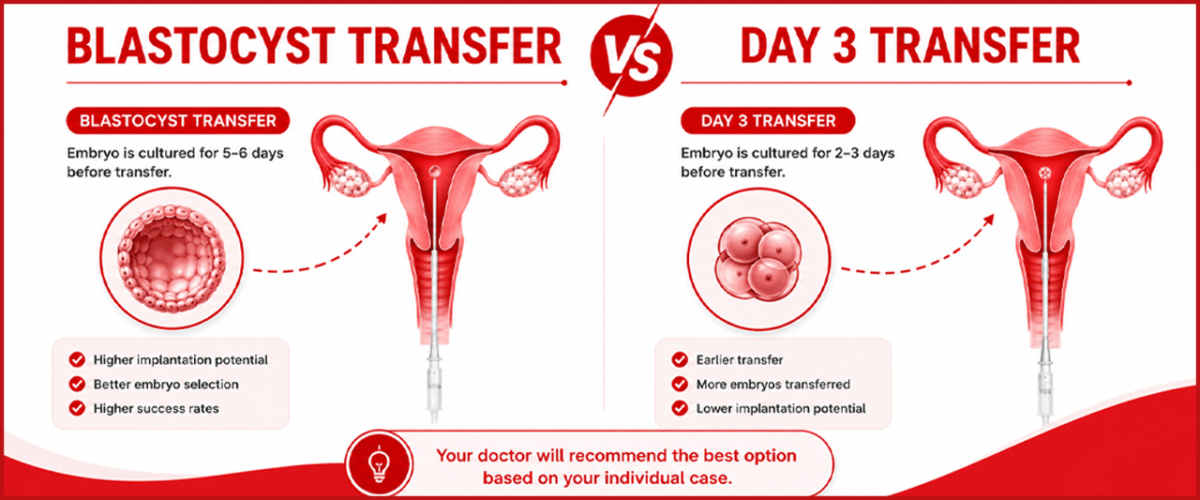
A Day 3 embryo transfer involves placing a cleavage-stage embryo into the uterus approximately three days after fertilisation.
At this stage, the embryo commonly contains around six to eight cells.
The main advantage of Day 3 transfer is that the embryo returns to the uterine environment earlier. This can be particularly relevant when only one or two embryos are available and the medical team is concerned about whether they will continue developing in extended laboratory culture.
Day 3 transfer is therefore not necessarily an inferior treatment option. In selected patients, it can be a reasonable approach.
What Is a Day 5 Blastocyst Transfer?
A Day 5 embryo transfer, commonly called a blastocyst transfer, is performed after the embryo has continued developing in the laboratory for several additional days.
By this stage, the embryo has undergone significant development and can be assessed according to blastocyst morphology.
Embryologists may use grading systems such as the Gardner grading system, with grades such as 4AA, 4AB or 5AA.
Extended culture can help the embryology team identify embryos that have demonstrated the ability to continue developing to the blastocyst stage.
Day 3 vs Day 5 Embryo Transfer
| Factor | Day 3 Transfer | Day 5/6 Blastocyst Transfer |
|---|---|---|
| Development stage | Cleavage-stage embryo | Blastocyst |
| Typical timing | Around 3 days after fertilisation | Around 5–6 days after fertilisation |
| Embryo selection | More limited at this stage | More information from extended development |
| Number of embryos reaching transfer | Potentially higher | Fewer embryos may reach blastocyst |
| Single embryo transfer | May be considered | Often well suited |
| PGT | Blastocyst biopsy is generally used | Suitable stage for trophectoderm biopsy |
| Risk of no embryo for transfer | Lower | Possible if embryos stop developing before blastocyst |
| Best approach | Depends on individual prognosis | Often considered for patients with suitable embryo numbers |
Does Day 5 Transfer Have a Higher IVF Success Rate?
This is one of the most common questions patients ask.
In appropriately selected patients, blastocyst transfer can offer higher implantation and clinical pregnancy rates per transfer compared with cleavage-stage transfer.
One reason is embryo selection. Continuing embryos in culture until Day 5 allows the embryology team to identify embryos that have successfully progressed to the blastocyst stage.
However, this does not mean that every patient will have a better overall chance of having a baby simply because the transfer is performed on Day 5.
The number of embryos available, embryo quality, maternal age, ovarian reserve, sperm factors, uterine factors and other clinical considerations all influence IVF outcomes.
Therefore, success should not be judged solely by comparing Day 3 and Day 5 transfer rates.
What Is the Main Disadvantage of Waiting Until Day 5?
The biggest concern with extended embryo culture is that not every embryo develops into a blastocyst.
If a patient starts with several good-quality embryos, this may allow the embryologist to select from the embryos that continue developing successfully.
But if only one or two embryos are available, there is a possibility that none may reach the blastocyst stage.
This is why the decision to culture embryos until Day 5 should be individualised rather than treated as a universal rule.
When Can Day 3 Transfer Be Considered?
A fertility specialist may consider Day 3 transfer in situations such as:
- Only one or two embryos are available.
- There is a concern about losing all embryos during extended culture.
- Previous cycles have resulted in poor blastocyst development.
- The patient’s individual clinical circumstances make earlier transfer appropriate.
- The fertility team believes that an earlier transfer may be more suitable for the available embryos.
Day 3 transfer should not be viewed as a second-choice treatment. The right decision depends on the individual IVF cycle.
When Is Blastocyst Transfer Often Preferred?
Day 5 or Day 6 blastocyst transfer may be particularly useful when:
1. Several embryos are available
Having multiple embryos provides more opportunity for selection after extended culture.
2. Single embryo transfer is planned
Transferring one suitable blastocyst can help reduce the risk of multiple pregnancy while maintaining a good chance of implantation in appropriately selected patients.
3. Genetic testing is planned
When preimplantation genetic testing is indicated, embryo biopsy is generally performed at the blastocyst stage.
4. The patient has a favourable prognosis
For patients with an appropriate number of developing embryos, extended culture can provide additional information for embryo selection.
Can Embryo Grading Predict IVF Success?
Embryo grading helps embryologists describe the appearance and development of an embryo, but grading alone cannot guarantee pregnancy.
A blastocyst may receive a favourable morphological grade and still fail to implant. Conversely, embryos with less favourable morphology can sometimes result in healthy pregnancies.
Other biological factors, including chromosomal status, also influence implantation and pregnancy.
This is why embryo grading should be considered one part of the overall IVF assessment rather than a guarantee of success.
Does Blastocyst Transfer Increase the Chance of Identical Twins?
Studies have reported a somewhat higher rate of monozygotic or identical twinning following blastocyst transfer compared with cleavage-stage transfer.
However, identical twinning remains relatively uncommon.
Importantly, single embryo transfer substantially reduces the overall risk of a multiple pregnancy compared with transferring multiple embryos.
Your fertility specialist can explain the risks and benefits based on your specific treatment plan.
Day 3 or Day 5: Which Embryo Transfer Is Better?
There is no universally better day.
The better question is:
“Which transfer strategy is most appropriate for my embryos and my IVF treatment?”
For a patient with several good-quality embryos, Day 5 blastocyst culture may provide useful additional selection and can be especially helpful when single embryo transfer or genetic testing is planned.
For a patient with very few embryos, Day 3 transfer may sometimes be considered to avoid the possibility of having no embryo available after extended culture.
The decision should be made after reviewing the actual embryo development in your cycle.
Day 3 vs Day 5 Embryo Transfer at Imprimis IVF Centre
At Imprimis IVF Centre, embryo transfer decisions are individualised according to the patient’s treatment plan and embryo development.
Our fertility and embryology team evaluates factors such as embryo number, embryo development, patient age, previous IVF history and whether genetic testing is being considered before recommending an appropriate transfer strategy.
Where clinically appropriate, extended embryo culture and blastocyst development can be considered, while Day 3 transfer may also be recommended for selected patients.
The goal is not simply to transfer an embryo on a particular day. The goal is to choose the strategy that gives the patient the most appropriate opportunity for a successful pregnancy.
Looking for IVF Treatment in Kashmir?
Choosing an IVF centre is an important decision. Patients should consider the experience of the fertility specialists, embryology laboratory, treatment protocols, counselling support and the way individual cases are managed.
If you are searching for the best IVF centre in Srinagar or an IVF centre in Kashmir, speak with a qualified fertility specialist before deciding between Day 3 and Day 5 embryo transfer.
At Imprimis IVF Centre, our team provides personalised fertility consultation and explains available treatment options according to each patient’s individual circumstances.
Frequently Asked Questions
Is Day 5 embryo transfer better than Day 3?
Not necessarily for every patient. Day 5 transfer can provide additional embryo selection, but Day 3 transfer may be considered when only a few embryos are available.
How many cells does a Day 3 embryo have?
A normally developing Day 3 cleavage-stage embryo commonly has around 6–8 cells, although development can vary.
What is a blastocyst?
A blastocyst is a more advanced stage of embryo development, usually reached around Day 5 or Day 6 after fertilisation.
Is PGT performed on Day 3 embryos?
Current clinical PGT practice generally involves biopsy at the blastocyst stage rather than routine Day 3 embryo biopsy.
Can one embryo be transferred on Day 5?
Yes. Single blastocyst transfer is commonly used when clinically appropriate and can help reduce the risk of multiple pregnancy.
Which is better for low ovarian reserve: Day 3 vs Day 5 Embryo Transfer
There is no universal answer. When only a small number of embryos are available, your fertility specialist may consider whether Day 3 transfer or extended culture is more appropriate for your individual situation.
Take the Next Step Towards Parenthood
If you are considering IVF treatment in Kashmir and are unsure whether Day 3 or Day 5 embryo transfer is appropriate, discuss your individual embryo development and treatment history with a fertility specialist.
Imprimis IVF Centre is committed to providing personalised fertility care, advanced embryology support and clear guidance throughout your IVF journey.
From Hope to Happiness — Your Parenthood Journey Starts With the Right Guidance.