Fresh vs Frozen Embryo Transfer: Which Gives You the Best Chance?
Fresh vs Frozen Embryo Transfer: A generation ago, the plan was simple: create embryos, transfer the best one a few days later, freeze any spares as a backup. Fresh was the main event; frozen was the understudy.
That script has flipped. Today many clinics freeze every embryo and transfer in a later month a “freeze-all” approach, and you’ll often read online that frozen transfers work better. It’s a tidy story. It’s also too simple, and if you take it at face value you might worry unnecessarily or push for the wrong option.
Here’s what fresh and frozen transfers actually are, what the current evidence says about success and safety, and how to work out which one fits you, because the honest answer is that it depends on your body, not on a headline. Learn more about IVF treatment at Imprimis IVF and the different treatment options available.
Understanding Fresh and Frozen Transfers
What “Fresh” and “Frozen” Mean in IVF
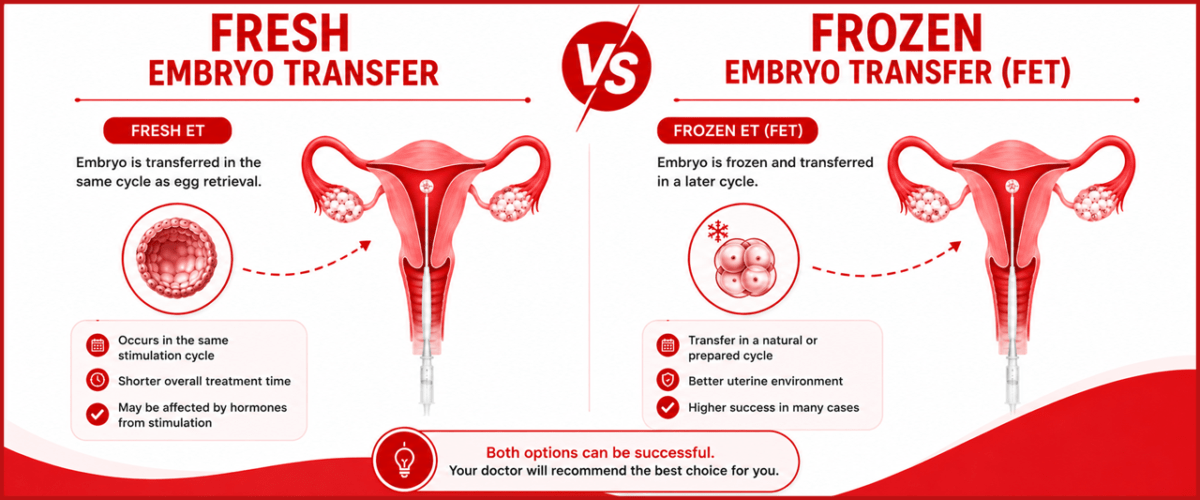
A fresh embryo transfer happens in the same cycle as your egg retrieval. Three to five days after your eggs are collected and fertilised, the best embryo is placed into your uterus while your body is still carrying the effects of the stimulation medication.
A frozen embryo transfer (FET) separates the two events. All the embryos are frozen after retrieval, your body is given time to return to its natural rhythm, and the transfer happens in a later cycle. Read more about IVF treatment in Srinagar.
The technology that made frozen viable is called vitrification, an ultra-fast freezing method that prevents ice crystals from forming and damaging the embryo. It works remarkably well: the large majority of vitrified embryos survive thawing intact, which is why “frozen” no longer means “second-best.”
Why More IVF Patients Are Choosing Frozen Transfers
The rise of freeze-all wasn’t a fad. It solved several real problems at once.
It prevents OHSS. In women who respond strongly to stimulation, pregnancy hormones can worsen ovarian hyperstimulation syndrome. Freezing all embryos and transferring later, once the ovaries have settled, sidesteps that danger. It enables genetic testing. If you’re having PGT, embryos are biopsied and then frozen while the results come back, so a frozen transfer is the only way to use a tested embryo. And it can improve the uterine environment. During a fresh, stimulated cycle, hormone levels run far higher than nature ever intended; high estrogen and an early rise in progesterone can make the lining less receptive to an embryo. A frozen cycle allows the transfer to occur in a calmer, more natural hormonal setting.
On top of that, FET supports single embryo transfer, offers scheduling flexibility, and underpins fertility preservation. Good reasons, all of them, but notice they’re reasons that apply to particular situations, which is the whole point of what follows.
Fresh vs Frozen Embryo Transfer Success Rate: What Does the Evidence Say?
This is where the internet oversimplifies, so let’s be precise. Whether frozen beats fresh depends largely on how your ovaries responded.
Fresh vs FET (Frozen Embryo Transfer) for High Responders and PCOS
If you’re a high responder lots of eggs, high hormone levels, or PCOS frozen tends to win. A landmark trial found that among women with PCOS, elective frozen transfer produced higher live-birth rates than fresh. Meta-analyses point the same way when many eggs are collected. Here, the fresh cycle’s sky-high hormones work against the lining, so stepping back and transferring frozen genuinely helps, and it protects you from OHSS at the same time.
Fresh vs FET (Frozen Embryo Transfer) for Normal Responders
If you’re a normal responder with regular ovulation, the two are essentially equal. A large randomised trial of over two thousand ovulatory women found no meaningful difference in live-birth rates between fresh and frozen (roughly 50% either way). For this group, freezing everything mainly adds time and cost without improving the odds.
Fresh vs Frozen Embryo Transfer for Low Responders
If you’re a low responder or have a poorer prognosis few eggs, older age recent evidence suggests fresh may actually be the better bet. A 2025 randomised trial in women with a low chance of success found higher live-birth rates with fresh transfer than frozen, both after the first transfer and cumulatively over a year.
The takeaway is not “frozen is better” or “fresh is better.” It’s that the right strategy is matched to your ovarian response and prognosis. Patients considering fertility treatment in Srinagar can discuss whether fresh or frozen embryo transfer is more appropriate for their individual situation.
Fresh vs Frozen Embryo Transfer and Pregnancy Outcomes
Success rates aren’t the only thing that matters; the health of the pregnancy does too, and this is the part most articles skip entirely.
Large reviews have found a consistent pattern in single-baby pregnancies. Fresh transfers carry a somewhat higher risk of babies being small for their gestational age, of low birth weight, and of preterm birth. Frozen transfers flip that: they’re linked to a lower risk of those outcomes, but a higher risk of babies being large for gestational age, and a higher risk of hypertensive disorders of pregnancy, most notably pre-eclampsia.
Before that worries anyone: these are differences in risk, not certainties, and the great majority of both fresh and frozen pregnancies are healthy. But there’s an important, actionable detail hiding inside the frozen numbers.
Frozen Embryo Transfer and the Corpus Luteum: Why FET Cycle Type Matters
Natural vs Programmed Frozen Embryo Transfer
The higher pre-eclampsia risk with frozen transfers isn’t really about freezing at all. It’s about how the uterus is prepared for the transfer, and it comes down to a small structure called the corpus luteum.
When you ovulate naturally, the ovary forms a corpus luteum that produces not just progesterone but a range of hormones that help your blood vessels adapt to pregnancy. A programmed (medicated) FET cycle uses estrogen and progesterone tablets or injections to build the lining without ovulation, so there’s no corpus luteum, and those protective vascular factors are missing. A natural or modified-natural cycle FET, used in women who ovulate, keeps the corpus luteum in play.
The difference in the data is striking. In one large cohort, pre-eclampsia occurred in about 8.6% of programmed FET pregnancies versus 3.8% of natural-cycle ones. Crucially, natural-cycle frozen transfers carry a pre-eclampsia risk similar to fresh transfers, and studies show natural and programmed cycles give equal live-birth rates. In other words, for a woman who ovulates, choosing a natural-cycle FET can lower a real pregnancy risk without costing her any chance of success.
This is the kind of nuance worth asking your clinic about directly if a frozen transfer is on the table.
How Does a Frozen Embryo Transfer (FET) Cycle Work?
If you’re heading for a FET, here’s the shape of it. Your embryos are already vitrified and stored safely. In the transfer month, your clinic prepares your uterine lining in one of two ways: a natural cycle, where they track your own ovulation and time the transfer to it, or a medicated (programmed) cycle, where estrogen and progesterone are given to build and time the lining. Once the lining is ready usually a nicely thickened, receptive endometrium the chosen embryo is thawed and transferred in the same quick, catheter-based procedure used for a fresh transfer. Progesterone support continues afterwards to sustain the lining while you wait for the pregnancy test.
Fresh vs Frozen Embryo Transfer: Head-to-Head Comparison
| Factor | Fresh Transfer | Frozen Transfer (FET) |
|---|---|---|
| Timing | Same cycle, 3–5 days after retrieval | A later cycle, after the body resets |
| Hormonal environment | High, stimulated hormone levels | Calmer, more natural (or medicated) |
| OHSS risk | Higher in strong responders | Avoided by transferring later |
| PGT compatible | No (no time for results) | Yes — the standard route |
| Success — high responders / PCOS | Lower | Higher |
| Success — normal ovulatory | Comparable | Comparable |
| Success — low responders | May be better | May be lower |
| Baby outcomes | More small-for-dates, low birth weight, preterm | More large-for-dates; more pre-eclampsia (mainly in medicated cycles) |
| Time & cost | Faster, usually lower cost | Adds a cycle, freezing and storage costs |
When a Fresh Transfer May Be Recommended
Fresh can be the better call when your ovaries responded moderately or modestly, your hormone levels and uterine lining look good in the stimulation cycle, you’re not at risk of OHSS, and you’re not planning genetic testing. For low responders in particular, current evidence suggests fresh may edge ahead. It’s also quicker and generally less expensive, since it avoids a second cycle and storage fees.
When a Frozen Transfer May Be Recommended
Frozen is usually the wiser path if you’re a high responder with lots of eggs, high hormone levels, or PCOS; frozen tends to win. Patients can discuss their individual fertility options with the specialists at Imprimis IVF. It’s also the natural choice when you want to bank embryos for the future. And if you do go frozen and you ovulate normally, it’s worth discussing a natural-cycle preparation to keep pregnancy risks low.
Fresh vs Frozen: Which Option Is Right for You?
Neither, as a blanket rule, and any source telling you otherwise is selling simplicity, not truth.
For a high responder or a woman with PCOS, frozen usually offers a better and safer outcome. For a normal ovulatory patient, the two are about even, so the extra time and cost of freezing should have a clear reason behind it. For a low responder, fresh may actually give the higher chance. And whichever you choose, the details matter especially, for frozen cycles, whether the lining is prepared naturally or with medication.
The best version of this decision is made with your fertility specialist, based on how many eggs you produced, your hormone levels, your uterine lining, whether you’re testing embryos, and your own health. That’s not a hedge; it’s genuinely how modern IVF gets the best results.
The Imprimis IVF Approach to Fresh vs Frozen Embryo Transfer
At Imprimis IVF, fresh versus frozen isn’t a default setting; it’s a decision built around you. With an in-house embryology lab and reliable vitrification, embryos can be frozen safely whenever a freeze-all protects you, whether that’s to prevent OHSS in a strong responder or to allow genetic testing. Equally, a fresh transfer is chosen when that’s what your body and prognosis call for. And when a frozen transfer is right, the team gives real thought to how your cycle is prepared because small choices, like a natural-cycle preparation where it’s appropriate, can make a pregnancy safer. Throughout, the promise is the same: personalised guidance and full transparency about what’s best for you and why.
If you’re weighing fresh against frozen, the most useful next step is a conversation about your own response and prognosis. Learn more about IVF treatment and fertility care in Srinagar.