IVF Procedure Step by Step: What to Expect During IVF Treatment
Starting IVF treatment can feel overwhelming, especially when you are unsure about what happens at each stage. Understanding the IVF procedure step by step can help you prepare for the physical, emotional and practical aspects of treatment.
In vitro fertilisation (IVF) is an assisted reproductive technology in which eggs are retrieved from the ovaries and fertilised with sperm in a laboratory. Clinicians monitor the resulting embryos, and a suitable embryo may be transferred into the uterus.
The exact treatment plan differs from one patient to another depending on factors such as age, ovarian reserve, sperm quality, medical history, previous fertility treatment and the clinic’s treatment protocol.
At Imprimis IVF & Fertility Centre, Srinagar, patients receive individualised fertility evaluation and guidance throughout their treatment journey.
In this guide, we explain the IVF procedure, major stages of an IVF cycle, what happens during egg retrieval and embryo transfer, and what patients can expect after treatment.
What Is IVF?
IVF, or in vitro fertilisation, is a fertility treatment that helps fertilisation take place outside the body in a controlled laboratory environment.
During an IVF cycle, fertility medications are generally used to stimulate the ovaries to develop multiple follicles. The eggs are then retrieved and fertilised with sperm in the embryology laboratory.
Depending on the treatment plan, fertilisation may be performed using conventional IVF or ICSI (intracytoplasmic sperm injection).
The resulting embryos are cultured and monitored before selecting an appropriate embryo for transfer or freezing.
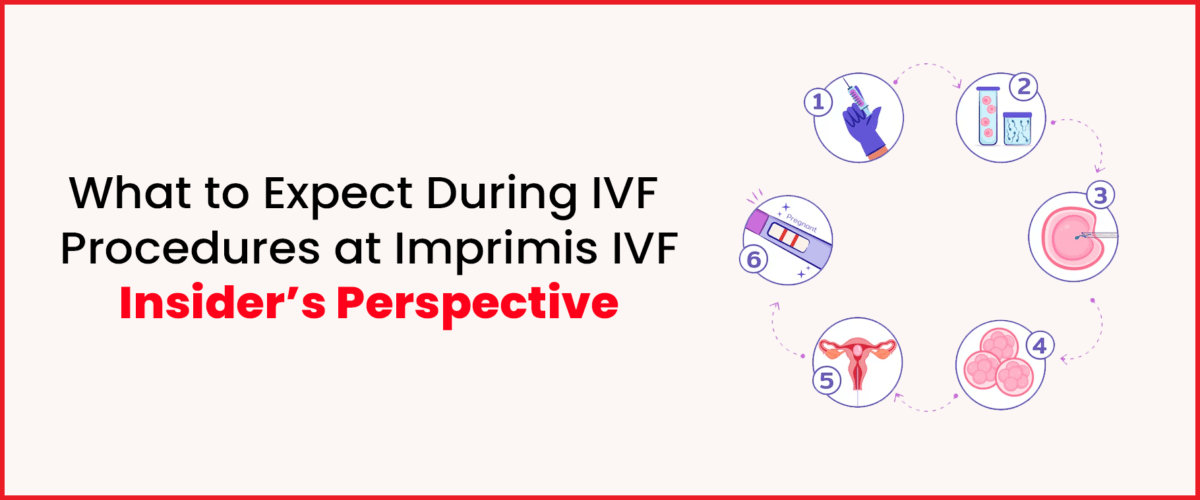
IVF Procedure Step by Step
The IVF treatment process generally includes several stages:
- Initial consultation and fertility assessment
- Ovarian stimulation
- Monitoring of follicular development
- Trigger medication
- Egg retrieval
- Sperm collection and preparation
- Fertilization
- Embryo development and culture
- Embryo transfer or embryo freezing
- Pregnancy testing and follow-up
The number of days and specific medications can vary between patients.
1. Initial IVF Consultation and Fertility Assessment
The IVF journey begins with a detailed consultation.
Your fertility specialist may review:
- Medical history
- Previous pregnancies and fertility treatments
- Menstrual cycle
- Age and reproductive history
- Ovarian reserve
- Sperm parameters
- Previous surgeries or medical conditions
- Lifestyle factors
Depending on the individual situation, the doctor may recommend blood tests, ultrasound, semen analysis or other fertility investigations.
This evaluation aims to identify possible causes of infertility and develop an individualised treatment plan.
2. Ovarian Stimulation
Ovarian stimulation is an important stage of the IVF process.
Fertility medications containing hormones called gonadotropins may be prescribed to encourage the ovaries to develop multiple follicles rather than relying on the single follicle that typically develops during a natural menstrual cycle.
Depending on the treatment protocol, the team may also use medications that regulate ovulation.
During stimulation, the fertility team monitors follicular development using:
- Ultrasound scans
- Blood tests when appropriate
- Clinical assessment
The fertility team adjusts the treatment protocol based on the patient’s response.
3. Trigger Medication
Once the follicles have developed sufficiently, your fertility team gives a trigger medication to help the eggs complete final maturation.
The timing of the trigger is important because egg retrieval is usually scheduled approximately 34–36 hours later, before spontaneous ovulation.
Your fertility team will provide specific instructions about when to administer the medication.
4. Egg Retrieval
Egg retrieval, also called oocyte retrieval or ovum pickup (OPU), collects mature eggs from the ovaries.
The procedure is generally performed using transvaginal ultrasound guidance.
A fine needle is guided through the vaginal wall into the ovarian follicles, and the follicular fluid containing the eggs is aspirated.
The procedure is generally performed under sedation or anaesthesia, depending on the clinic’s protocol and the patient’s needs.
The embryology laboratory immediately receives the retrieved eggs for assessment.
5. Sperm Collection and Preparation
On the day of egg retrieval, the male partner will usually provide a semen sample.
The laboratory team processes the sample to identify suitable sperm for fertilisation.
In some cases of severe male-factor infertility, sperm may need to be obtained using a surgical sperm-retrieval procedure.
Depending on the clinical situation, clinicians may perform fertilisation through conventional IVF or ICSI.
6. Fertilisation
After egg retrieval and sperm preparation, embryologists perform fertilisation in the embryology laboratory.
Conventional IVF
In conventional IVF, embryologists place prepared sperm and mature eggs together in a laboratory dish under controlled conditions, allowing fertilisation to occur.
ICSI
With ICSI, an embryologist injects a single selected sperm directly into a mature egg.
ICSI may be considered in certain situations, particularly when significant sperm-related factors are present or there have been previous fertilisation problems.
The appropriate fertilisation method depends on the patient’s individual circumstances.
7. Embryo Development and Culture
After fertilisation, the embryology team monitors embryo development.
Embryos go through several developmental stages over the next few days.
Some embryos may develop into blastocysts around day 5 or 6.
Embryologists assess embryo development and determine which embryos are suitable for transfer or freezing based on the treatment plan.
Not every fertilised egg will necessarily develop into a blastocyst.
8. Embryo Transfer
Embryo transfer is one of the final stages of an IVF cycle.
A selected embryo is placed into the uterus using a thin, flexible catheter.
The procedure is generally brief and usually does not require anaesthesia.
The number of embryos transferred depends on factors such as:
- Patient age
- Embryo quality
- Previous treatment history
- Medical circumstances
- Applicable clinical recommendations
In appropriate patients, single embryo transfer may be recommended to reduce the risk associated with multiple pregnancy.
9. Fresh or Frozen Embryo Transfer
Fresh vs Frozen Embryo Transfer: Not every IVF cycle involves an immediate fresh embryo transfer.
Depending on the patient’s medical condition and treatment plan, clinicians may freeze embryos using vitrification and transfer them during a later menstrual cycle.
A frozen embryo transfer (FET) may be recommended when:
- The uterine lining requires additional preparation
- Hormonal conditions make delayed transfer preferable
- Embryos are being preserved for future use
- Genetic testing is planned or has been performed
- The fertility specialist recommends postponing transfer
The choice between fresh and frozen transfer is individualised.
10. Pregnancy Test After Embryo Transfer
After embryo transfer, patients are advised to follow the testing schedule provided by their fertility team.
A beta-hCG blood test is commonly used to determine whether pregnancy has occurred.
Testing too early can produce misleading results, so patients should generally wait until their fertility specialist recommends.
If the result is positive, follow-up appointments and ultrasound examinations are scheduled to monitor early pregnancy development.
How Long Does the IVF Procedure Take?
The duration of an IVF cycle varies from patient to patient.
Ovarian stimulation typically takes 8–14 days, though protocols vary.
When you consider the entire process—from the initial assessment through embryo transfer—the timeline may extend over several weeks.
If you freeze embryos for later transfer, the overall treatment timeline can be longer.
Your fertility specialist can provide a more accurate schedule based on your specific treatment protocol.
What Does IVF Feel Like?
The IVF experience varies from person to person.
During ovarian stimulation, some women may experience:
- Bloating
- Abdominal discomfort
- Breast tenderness
- Mood changes
- Mild pelvic discomfort
Clinicians use pain-management measures, such as sedation or anaesthesia, during egg retrieval, depending on the clinical setting.
After embryo transfer, some patients experience mild cramping or spotting, while others experience no noticeable symptoms.
Symptoms, or the lack of them, do not reliably indicate whether IVF has been successful.
What Happens After Embryo Transfer?
After embryo transfer, patients are generally advised to continue prescribed medications and follow their fertility team’s instructions.
Patients can usually resume normal daily activities as their doctor advises. Routine strict bed rest is not generally required after embryo transfer.
Patients should contact their fertility clinic if they experience significant pain, heavy bleeding, breathing difficulty or other concerning symptoms.
IVF Success Rate: What Factors Matter?
IVF success does not depend on a single factor.
Important factors can include:
- Woman’s age
- Egg quality
- Ovarian reserve
- Sperm quality
- Embryo quality
- Uterine and endometrial factors
- Underlying medical conditions
- Previous IVF history
- Laboratory and embryology factors
Therefore, a clinic should not promise a specific pregnancy or live-birth outcome for an individual patient.
If you are researching IVF success rates in India, ask the fertility centre how it calculates its statistics and whether the figures are broken down by age and treatment type.
Why Personalised IVF Treatment Matters
Every fertility journey is different.
Two couples of the same age may require completely different treatment approaches because infertility can result from female factors, male factors, combined factors, or sometimes remain unexplained.
At Imprimis IVF, treatment planning may involve fertility specialists, embryologists and other healthcare professionals working together to determine an appropriate treatment strategy.
The goal is not simply to perform an IVF cycle but to understand the patient’s fertility needs and provide appropriate care throughout the process.
Frequently Asked Questions About IVF Procedure
Is IVF painful?
Some stages of IVF, particularly ovarian stimulation and egg retrieval, may cause discomfort. Clinics often use sedation or anaesthesia for egg retrieval to improve patient comfort.
How many injections are needed during IVF?
The number of injections varies depending on the patient’s ovarian reserve, age, treatment protocol and response to medication. No single number applies to every IVF cycle.
How many eggs are needed for IVF?
No universal number of eggs guarantees pregnancy. The number of eggs retrieved depends on ovarian reserve and how the patient responds to stimulation.
How long after embryo transfer is pregnancy confirmed?
Your fertility clinic will provide a specific testing date. A beta-hCG blood test is commonly used to confirm pregnancy after embryo transfer.
Can IVF fail even when good-quality embryos are available?
Yes. Embryo quality is important, but implantation and pregnancy depend on multiple biological factors. A good-quality embryo does not guarantee implantation or a successful pregnancy.
Is IVF successful on the first attempt?
Some patients achieve pregnancy during their first IVF cycle, while others may require additional treatment. Success depends on several individual factors, including age, egg and sperm quality, embryo development and underlying fertility conditions.
What happens if there are extra embryos?
Clinicians may freeze suitable embryos that aren’t transferred for potential future use, depending on their quality and the patient’s treatment plan.
Final Thoughts: IVF procedure
Understanding the IVF procedure step by step can make the fertility journey easier to navigate. From the initial fertility assessment and ovarian stimulation to egg retrieval, fertilisation, embryo culture and embryo transfer, each stage has an important role in the treatment process.
However, IVF is not a one-size-fits-all treatment. Your fertility specialist will determine the most appropriate protocol based on your medical history, reproductive health and treatment goals.
At Imprimis IVF & Fertility Centre, patients receive individualised fertility evaluation, treatment planning and support throughout their IVF journey.
If you are considering IVF treatment in Srinagar or want to understand whether IVF is appropriate for your fertility concerns, consult a qualified fertility specialist for personalised medical advice.